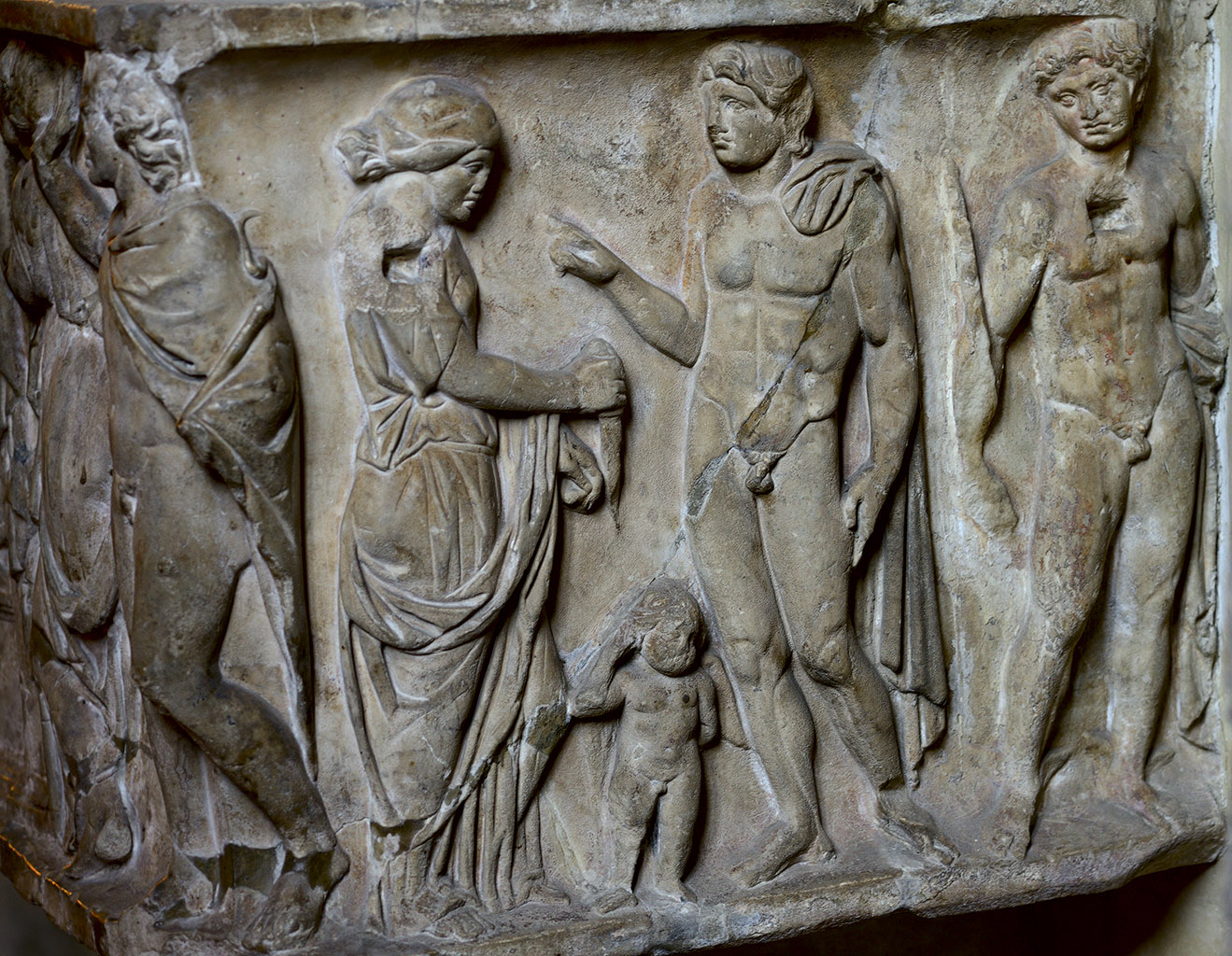
Sarcophagus with scenes of the myth of Protesilaus and Laodamia
Right side panel.Marble. Late 2nd century CE. Naples, Santa Chiara ChurchPhoto by Ilya Shurygin
Sarcophagus with scenes of the myth of Protesilaus and Laodamia.
Right side panel.
Marble. Late 2nd century CE.
Marble. Late 2nd century CE.
Naples, Santa Chiara Church.
Description:
On the right side panel of the sarcophagus the farewell of Protesilaus and Laodamia is depicted in the presence of Hermes Psychopomp, the guide of the souls of the deceased to the underworld. The figure of Hermes on the right, in winged sandals and holding a caduceus, is identical to the one on the frontal panel. In the center of the composition Protesilaus addresses his final words to Laodamia. Laodamia stands with her veiled head bowed; in her right hand she holds a dagger, and himation in the left hand. Unlike the scene of the couple’s reunion, where she joyfully looks into Protesilaus’s eyes, here her gaze is directed into emptiness, the gaze of a person who has already decided to bid farewell to life: she is experiencing the last moments before death.
Between the figures of the spouses, a small winged Eros raises his right hand in a farewell gesture.
Between the figures of the spouses, a small winged Eros raises his right hand in a farewell gesture.
The source of the plot for this relief was probably Pseudo-Apollodorus’s "Epitome" (E. IV 3. 30), which tells us that "...when he (Protesilaus) was led back to Hades, she (Laodamia) committed suicide." The original text does not contain a direct indication of the method of Laodamia’s suicide (ἑαυτὴν ἐφόνευσεν), however, the verb φονεύωused by the author is more often applied to denote bloody methods of killing (slaughter, bloodshed). This is precisely how the ancient author of the relief envisioned Laodamia’s suicide, and it is this connotation of φονεύω that the renowned British religious scholar J.G. Frazer chose when translating Apollodorus’s "Library" into English ("...she stabbed herself to death").
Literature:
Giulio Minervini. Sarcofago con Protesilao e Laodamia in Napoli. Bullettino Archeologico Napoletano. N. XXII, 1844. P. 39-40; N. XXIII, 1844. P. 45-48; N. XLIII, 1845.
Oliverio G., Il sarcofago di Protesilao e Laodamia della chiesa di S. Chiara in Napoli (Cappella Sanfelice Bagnoli), in A. V. Sumbolae Litterariae in honorem Iulii de Petra, Napoli 1911. P. 303-319.
Apollodorus The Library. Translated by J. G. Frazer.
Oliverio G., Il sarcofago di Protesilao e Laodamia della chiesa di S. Chiara in Napoli (Cappella Sanfelice Bagnoli), in A. V. Sumbolae Litterariae in honorem Iulii de Petra, Napoli 1911. P. 303-319.
Apollodorus The Library. Translated by J. G. Frazer.
Credits:
Keywords: ελληνική μυθολογία mythologia graeca greek mythology mitologia greca griechische mythologie grecque ἑρμῆς ερμής ἑρμείας hermeias hermes ermes ermete hermès λαοδάμεια laodamia laodameia laodamie πρωτεσίλαος protesilaus protesilaos protesilao protésilas ἔρως έρως eros éros ρωμαϊκή romana roman römische romaine μερκούριους mercurius mercury mercurio merkur mercure γλυπτική sculptura sculpture sculptural scultura skulptur ρωμαϊκό romano romani römisch römisches römischen römischer romain romains romaines κηδεία funeral funerary funeraria funerario begräbnisskulptur beerdigung funéraire σαρκοφάγος σαρκοφάγους sarcophagus sarcophagi sarcofago sarcofagi sarkophag sarkophage sarcophage sarcophages mythological with a myth of myths mitologico mitologici con un mito i miti mythologischer mythologische mythologique mythologiques ανακούφιση relief rilievo church santa chiara cappella sanfelice